Single Coming soon
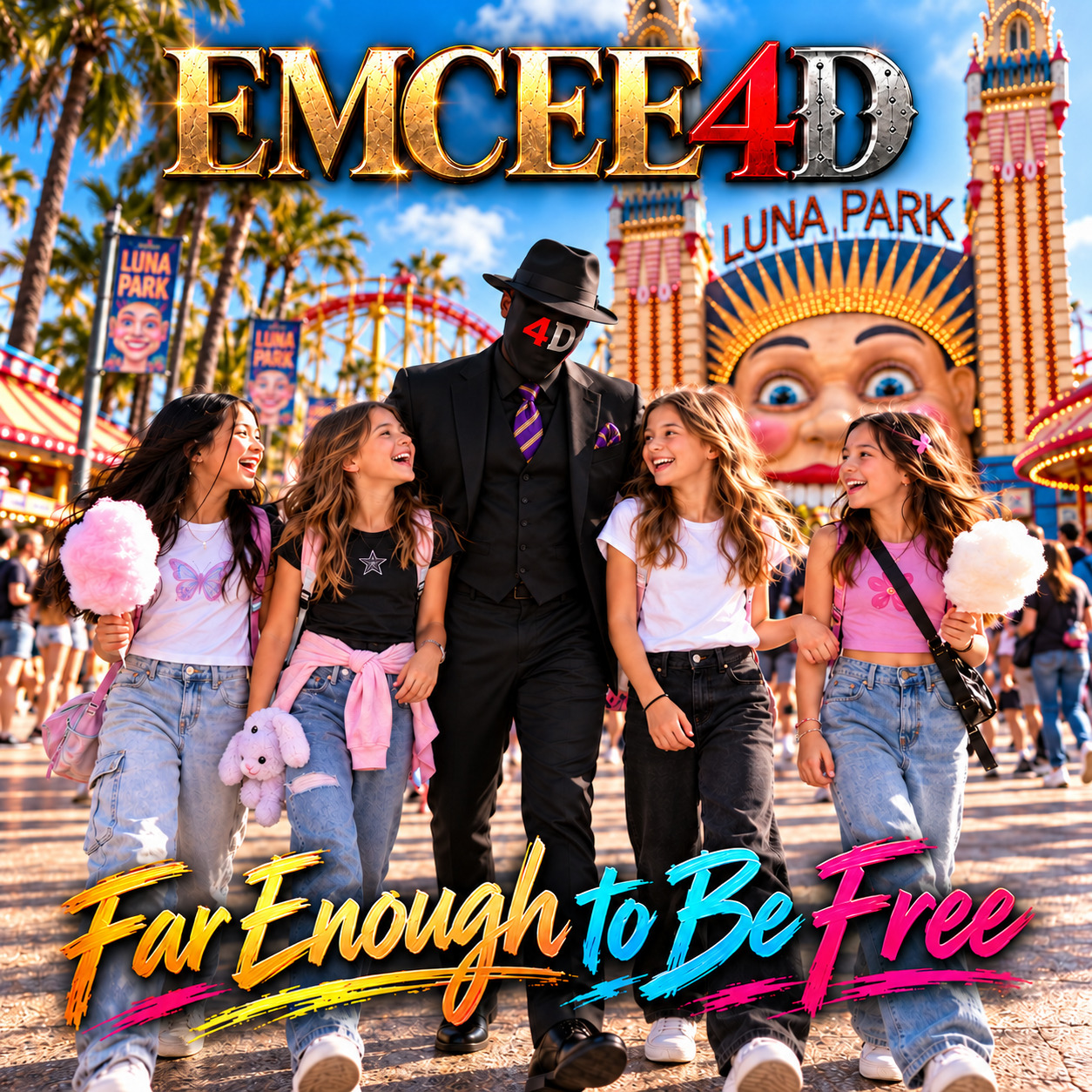
Far Enough to Be Free
Birthday rides, big laughs and one dad on bag duty.
Listen to the single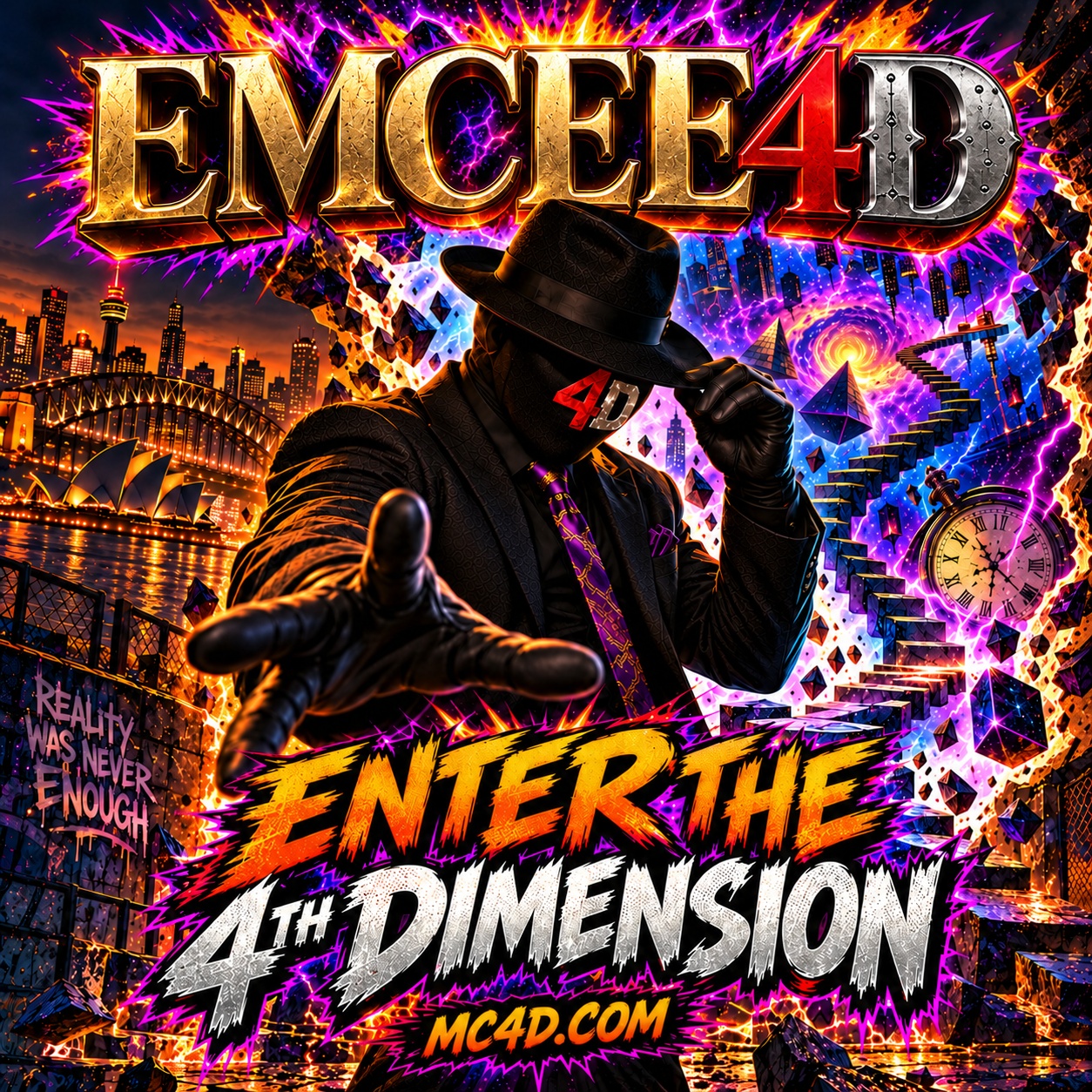
Website-Exclusive Single
Enter the 4th Dimension is a website-exclusive single by EMCEE4D. Released 15 October 2026.
Enter the 4th Dimension
EMCEE4DThree dimensions were enough to contain a life. Not enough to explain it.
Some doors stay closed long enough that a person stops asking for the key. In Enter the 4th Dimension, EMCEE4D turns professional silence, financial pressure and accumulated frustration into a problem of space: the room is not simply too small; its measurements may have been wrong from the beginning. A near-silent spoken opening gives way to low-end tension, clipped percussion and tightly measured Australian rap. The track moves from private reckoning to a confrontation with the frame around it, without pretending that a change of perspective erases the years that preceded it. This is a threshold, not a victory lap.
The first line makes a correction: “The Introduction … was only the introduction.” It is a pointed way of reopening something that appeared to have been settled. An introduction usually tells an audience who has arrived. This song asks a more uncomfortable question: who decided the dimensions in which that person was supposed to exist?
The title might suggest science fiction, and the supplied cover makes that invitation explicit. A Sydney skyline bends into a saturated comic-book universe of clocks, strange geometries and stairs disappearing into an electric void. But the writing keeps pulling the impossible imagery back to ordinary pressure. There are unpaid hopes, professional silences, expensive weeks and a stubborn commitment to work nobody has yet recognised. The fourth dimension is not offered as a scientific theory. It is the song’s language for refusing a definition that no longer fits.
The opening verse places its speaker somewhere unglamorous: working without applause, acquiring discipline through repetition, carrying experiences that have changed the sound of his voice. “No crowd, no co-sign” removes the fantasy of instant permission. Even the references to skill have an edge of disappointment. Being overqualified is not useful when the inbox remains cold. Competence and opportunity do not always arrive together.
Against that ordinary economic landscape, the geometry becomes sharper. Rooms, floor plans, frames and walls are not decorative references to the title; they are a way to show how an environment can mistake its limitations for the limits of the person inside it. The refrain “They boxed me in three dimensions. / I made a fourth” is defiant, but it also depends on the memory of confinement. The speaker has not forgotten the box. His new language still carries its outline.
The second movement compresses that idea into action. Short internal-rhyme patterns make the phrases seem to ricochet against one another: forced perspective, corrected courses, locked doors and dead ends. The brief images of pay disappearing into rent resist the idea that hardship is automatically romantic or creatively useful. Pressure does not deserve credit for what it damages. The song’s narrower claim is that the narrator has found a way to make something articulate from it.
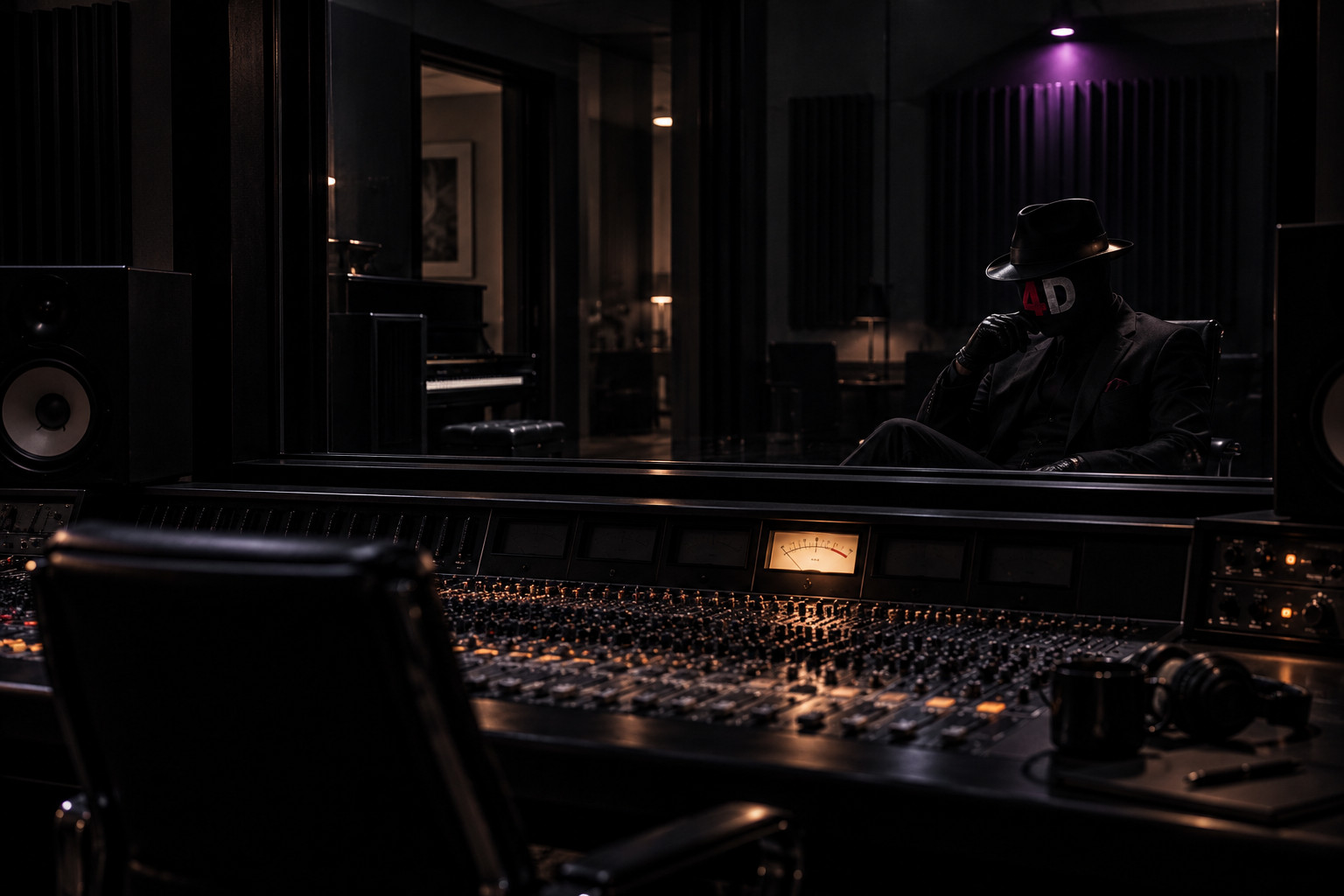
There is an intentional tension in the declaration that no legend has been manufactured. EMCEE4D has a highly developed visual identity, including the black-suited, fully masked figure on this cover. The lyric “I never built a persona” should not be flattened into a literal statement about wardrobe or branding. Within the song, it argues that the source of the voice is lived or deeply felt pressure rather than an invented history. The distinction matters: an image can be constructed without every feeling in the work being fictional; equally, first-person lyrics alone cannot authenticate a biography.
The production direction aims to stage an entrance rather than provide a conventional singalong. The plan begins with the voice almost alone. The arrangement is designed to build intensity while the vocal remains controlled, then cut suddenly after the name EMCEE4D. These are the stated production intentions, not listening observations.
By the ending, the song has moved from frustration with the room to direct address: “You didn’t find a website. / You found the entrance.” That is a clever reversal of a promotional assignment. Rather than simply advertise a domain, the track makes the listener part of the metaphor. Yet an entrance is not a guarantee of arrival. The song leaves the door open and refuses to say that everything beyond it will be easier.
A change in perspective can be real without turning the past into a success story.
A song described as an “entrance” carries a particular risk. It can confuse an invitation with an achievement and mistake a large visual gesture for an earned idea. This one tests its own scale by returning repeatedly to small, unpleasantly recognisable details: an inbox that stays cold, rent paid before anything else, a page worked on without an audience. Its surrounding artwork stages something vast and surreal, but the lyric begins with a person trying to make a voice under mundane constraints.
It is also a track with more than one audience. For someone arriving at MC4D.com for the first time, it is a dramatic introduction to EMCEE4D’s music. For a listener who knows The Introduction as an earlier release, the first line is a deliberate continuation rather than a claim that the earlier record did not matter. And for someone attentive to the writing, the fourth dimension is less a location than a refusal to take a given arrangement of the world as permanent.
The point is not that a listener must accept a heroic account of the narrator’s life. The stronger reading is about the relationship between pressure, perception and expression: what happens when experience does not match the categories available to describe it?
The opening verse has the shape of an inventory. No crowd. No co-sign. A mouth, a script, and years of accumulated resistance. The speaker’s first claim is not that success was inevitable, but that the work continued under conditions that offered little encouragement. “Overqualified” is paired with “no callback,” a combination that does not need a villain. It names a mismatch between ability and recognition. The resulting frustration is specific enough to avoid the easy spectacle of being “misunderstood.”

The writing then treats damage as something that can be heard. A bar has a bruise where pressure once lived; a page acquires a pulse. These are bodily images, but they are also craft images. A bruise records contact, while a pulse implies ongoing life. That contrast is important. The speaker does not simply announce that he survived. He describes a method of converting traces of past experience into meter, tone and emphasis.
The risk is that any account of transformation can become an advertisement for suffering: it hurt, therefore it was necessary. The details about missed opportunities resist that conclusion. Nothing in the lyric proves those lost years were worth losing. The artistic movement is narrower and more credible. Work can acquire form from a difficult history without retroactively making the history fair.
For all its references to doors and rooms, the song is not primarily about access. Access assumes a space one wants permission to enter. The more disruptive thought appears when the walls themselves begin to look provisional. “Same room, wrong shadow, walls lose symmetry” describes an alteration in perception before it describes a change in circumstances. The physical world has not necessarily moved. What changes is the narrator’s acceptance of its measurements.
This is where the title earns its exaggeration. “Three dimensions” is treated as a shorthand for a world with defined edges: a box, a set of rules, a floor plan somebody else has drawn. A fourth is invented as a rhetorical dimension, a way to think beyond the available description. There is no need to explain it as time, a supernatural power, or a literal portal. The metaphor works because its meaning is not pinned down to one technical definition.
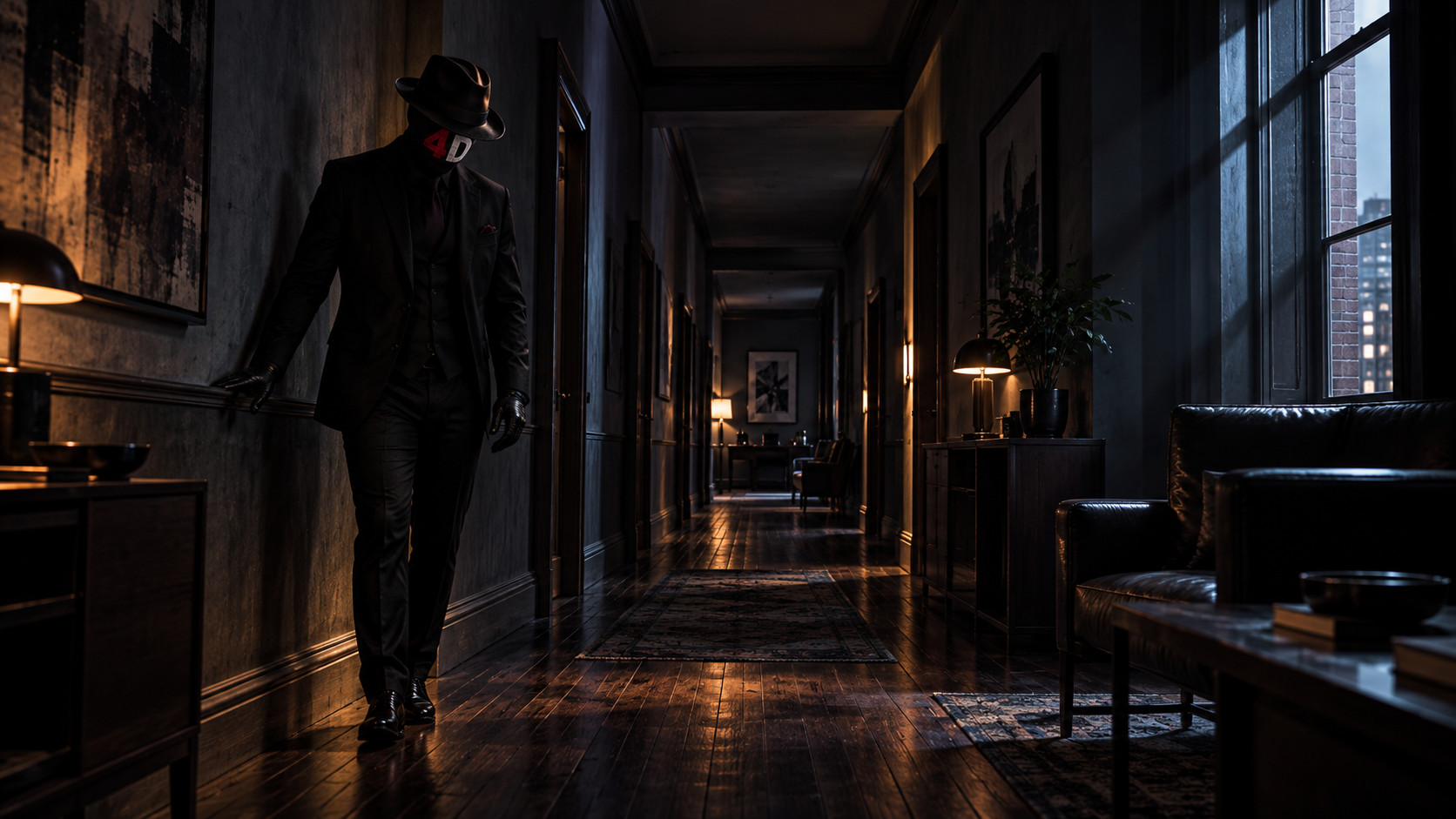
The supplied cover makes the idea visible in its own highly graphic idiom. The city on the left remains recognisable while the staircase, clock and cosmic forms on the right abandon ordinary perspective. Its outstretched foreground figure invites the viewer through that rupture. The masked EMCEE4D portrait, supplied separately, communicates a different kind of control: stillness, dark tailoring, concealment and a recognisable emblem. Those images do not need to depict the same literal scene to support one campaign.
Still, changing a floor plan is not the same as escaping one. Rent, work and time remain part of the song. Its best visual and editorial treatments should preserve that tension rather than turn the fourth dimension into a place where consequences disappear.
Halfway through the lyric the drums are meant to recede. The language grows deliberately plain: “No costume for pain. / No rented rebellion. / No manufactured legend.” It is the closest the song comes to an artistic manifesto, but a small contradiction immediately appears. EMCEE4D is also a performed identity with a mask, tailored suit and striking visual emblem. That does not invalidate the line. It sharpens the question of what kind of authenticity the song is defending.

There is a difference between constructing a recognisable artist and inventing hardship to make the artist marketable. The words ask the listener to make that distinction. Yet a listener cannot independently prove the narrator’s history from lyric alone, and the editorial must not pretend otherwise. What can be assessed is the discipline of the portrayal: the song resists convenient antagonists and tends to name conditions instead. Its anger is directed at a constricting frame more than at a named person.
The bridge also changes the rhythm of attention. After dense rhymes, simple declarative sentences sound almost exposed. The voice does not need to shout; space around it gives the claim weight. When the narrator says the room was the problem, the moment is less a motivational slogan than a diagnosis reached after repeatedly failing to inhabit an unsuitable set of expectations.
That diagnosis does not oblige every listener to agree. Sometimes a room must be changed; sometimes skills, timing or choices must change too. The song remains compelling when the line is allowed to be a fiercely held perspective, not a universal explanation for disappointment.
The production direction treats the first seconds as architecture. Silence makes the listener lean closer. A low spoken voice locates the threshold, then restrained harmonic material — an isolated piano note, a bent cello drone, a distant metallic impact — is meant to suggest dimensions that have not yet become stable. The bass is meant to enter slowly, so the first heavy beat feels like a new physical rule taking hold.
The rap can occupy a measured, heavy pulse while tighter internal rhymes create movement inside it. Consonants, not melody, carry much of the propulsion. The direction asks for a mature Australian voice and controlled aggression without shouting. That restraint matters because the lyric’s argument is about authority acquired through work, not volume as a substitute for it.
The hook is simpler than the verses. Its repetition of the threshold phrase provides orientation after rapidly compressed language, while the final arrangement calls for heavier drums and bass. The intended last cut removes the musical world suddenly after the EMCEE4D tag. The plan has no tidy fade-out or resolved final chord. In theory that leaves the listener back in the silence that opened the song, but now with a name and an invitation attached to it.
The closing address is almost deliberately impolite to the conventions of music promotion. The listener came for a website. The narrator insists that the website is only the outer surface of something else. A domain is normally a destination; here it becomes a doorway whose meaning depends on what the visitor hears after opening it.

There is a temptation to answer the song’s central question with the cover’s most spectacular image: a heroic leap through a cosmic tear. That would make the entrance the conclusion. The lyric does something less settled. After naming the artist, it ends. The work does not show who is waiting on the other side, whether a callback arrives, or whether the pressures that shaped the voice have lifted.
Perhaps the most consequential fourth dimension is the one introduced by the listener: another perspective able to hear an old room differently. That is a possibility, not a promise. The single can end precisely there.
The portal opens. The ordinary world has not agreed to disappear.
Birthday rides, big laughs and one dad on bag duty.
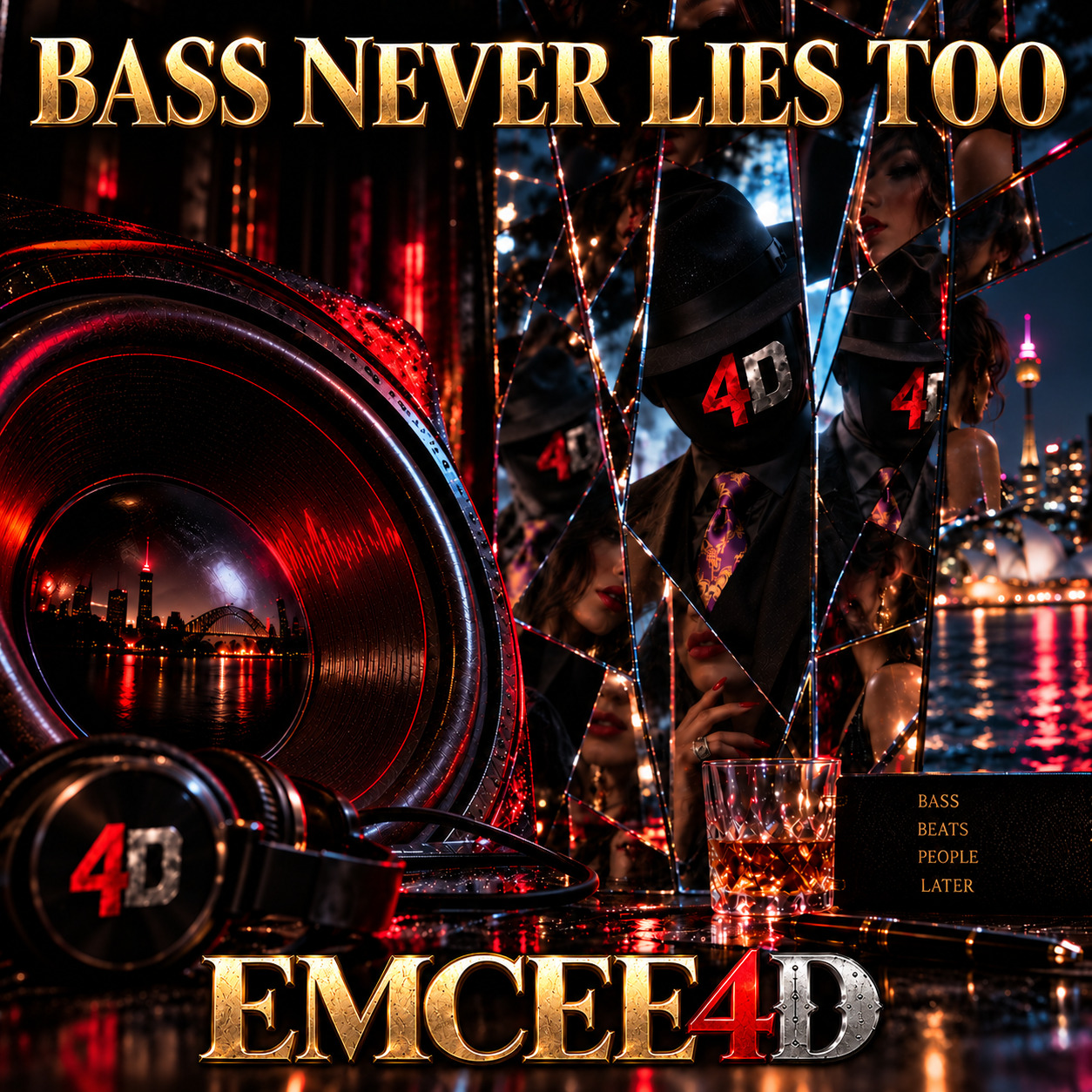
Listen to the singleOne drink. One hour. Then the bass changes the terms.
Listen to the single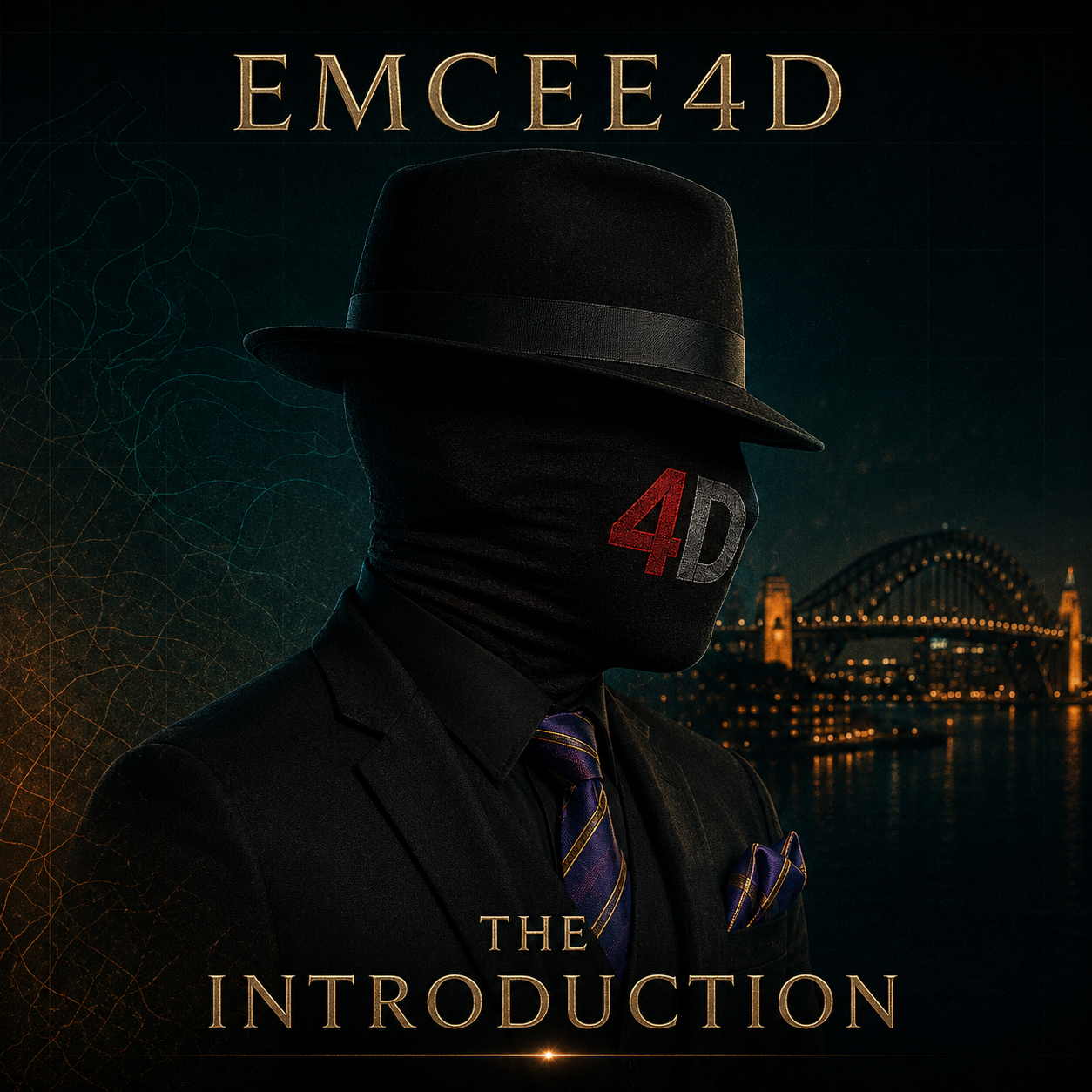
Every identity has an origin. Not every origin is comfortable.
Explore The Introduction, EMCEE4D's 16-track debut album. Australian rap confronting ambition, masculinity, identity and the pressure of being underestimated.
Explore The Introduction