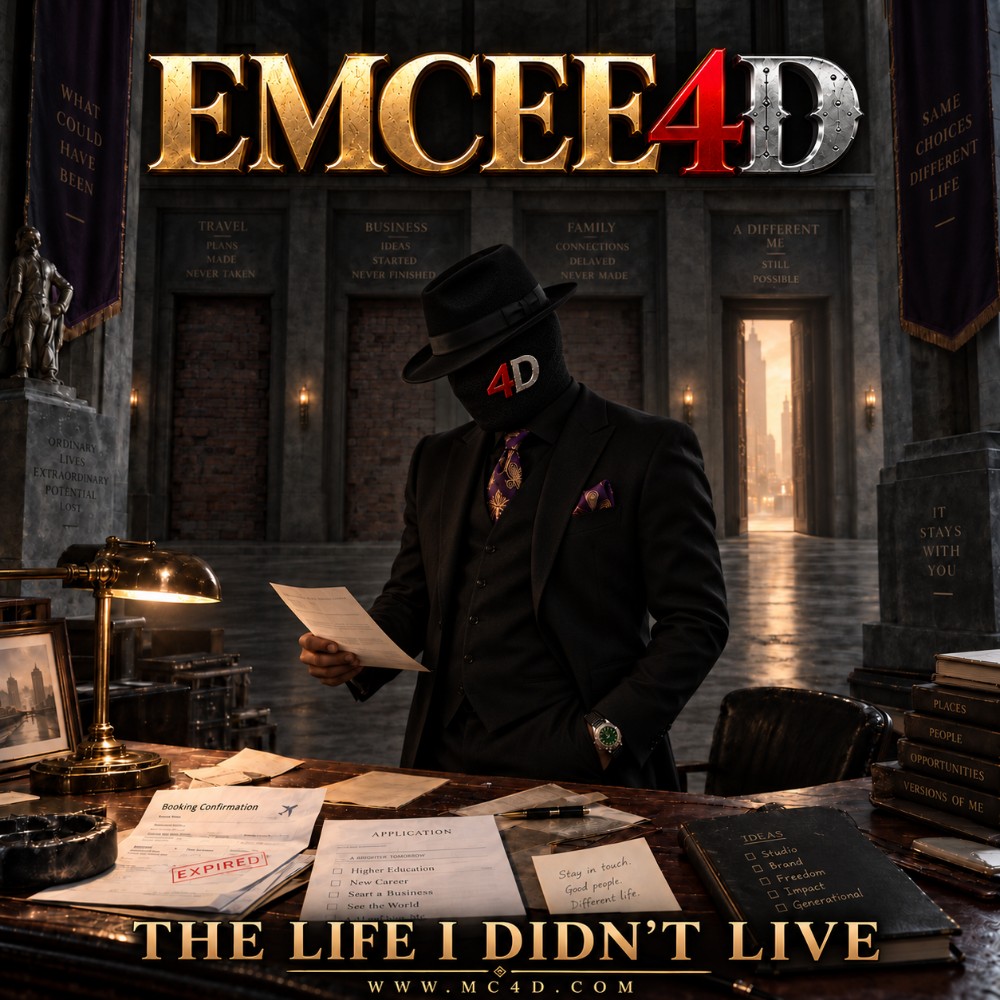
EMCEE4D · Fourth Album · 21 tracks · Listen now on mc4d.com — Official release 13 December 2026
What It Costs is a 21-track album by EMCEE4D, opening with “The Life I Didn't Live” and closing with “Move The Line”. Listen now on mc4d.com — Official release 13 December 2026.
What It Costs begins where easy advice stops being useful.
Everyone knows time matters. Everyone knows fear can hold a person back. Everyone knows that sometimes you have to leave, sometimes you have to stay, sometimes you have to work harder and sometimes you have to stop caring what everybody else thinks.
Knowing that is not the difficult part.
Living it is.
Across 21 tracks, EMCEE4D examines what happens when abstract principles meet actual consequences. Fear costs experience. Approval costs independence. Ambition costs time. Love costs vulnerability. Work costs comfort. Leaving can cost history. Staying can cost peace. Refusing to decide does not suspend the transaction.
It only makes the cost harder to see.
The record follows a man becoming increasingly suspicious of the idea that somewhere there is a perfect decision with no meaningful loss attached. The older he gets, the less convincing that fantasy becomes. Time is finite. Attention is finite. Energy is finite. Some doors close because he walks through another one. Some versions of life disappear simply because he cannot live all of them.
That does not make every sacrifice worthwhile.
It makes the choice more serious.
Early in the album, much of the pressure comes from what has not happened: things postponed, risks avoided, permission waited for, other people given too much authority. The absence of disaster begins to look less like proof that caution worked and more like evidence that nothing was tested.
Later, the pressure changes. The narrator acts and discovers that action does not solve everything either. Fear survives movement. Old habits survive new circumstances. Good intentions remain capable of producing bad evidence. Work still has to be done after the motivational feeling disappears. Connection arrives, but it does not simplify the person experiencing it.
That is where What It Costs becomes less interested in transformation as an idea and more interested in conduct. Not who do you say you are, but what keeps receiving your hours? What do you return to? What do you keep avoiding? What happens when you are wrong? What do you protect when two things matter at once?
The album never finds a cost-free answer.
It stops looking for one.
01
THE BILL STARTS BEFORE YOU MOVE
Some consequences announce themselves.
Others look like nothing happening.
That distinction drives the opening movement of What It Costs. Fear rarely introduces itself by saying that it intends to shrink a life. It can sound reasonable: wait a little longer, prepare more, think it through, avoid embarrassment, make sure. There will always be another opportunity.
Sometimes that advice is correct. That is what makes fear difficult to identify.
The album is not interested in pretending caution is weakness. There are risks that deserve to be avoided. There are decisions that should wait. The problem begins when caution stops responding to evidence and becomes the permanent default.
Then nothing dramatic needs to happen. A journey is never taken. An idea remains an idea. A conversation is postponed until there is no longer a conversation to have. Someone interesting becomes somebody once seen. A year disappears without producing either the catastrophe that was feared or the life that might have existed beyond it.
From the outside, that can look stable.
Inside it, something is being spent.
This is one of the record’s most persistent ideas: inaction has consequences even when it produces no visible event. A person can lose without failing. There is no wreckage to point at, no public mistake, no spectacular collapse — only absence.
And absence is difficult to audit because it leaves no photograph of what would have happened instead.
What It Costs begins by treating those missing experiences as real. Not as fantasy. As expenditure.
02
APPROVAL HAS A PRICE
Other people are good at having opinions about consequences they will never have to carry.
That becomes increasingly difficult for the narrator to ignore.
Approval initially appears valuable because it seems to reduce risk. If the right person agrees, the decision feels safer. If enough people approve, perhaps responsibility becomes lighter. If somebody with authority says yes, maybe failure will hurt less.
It does not work that way.
The person giving the advice goes home.
The person living with the result does not.
The question therefore stops being whether criticism should be ignored. Some criticism is accurate. Some people see things the narrator does not. Some warnings deserve to survive his ego.
The harder question is who has earned influence.
Not everyone who speaks confidently has. Not everyone who disapproves understands the situation. Not everyone offering instructions would follow those instructions themselves. And not everyone who means well is qualified to determine another person’s life.
That creates a difficult form of independence. Refusing unnecessary permission sounds liberating until the protection disappears with it. If nobody else gets to make the decision, nobody else gets to own the result.
Autonomy removes an excuse.
That is why the album’s movement away from approval is not presented as rebellion. It is presented as responsibility.
You can stop asking for permission.
You cannot stop answering for what happens next.
03
FEAR COMES WITH YOU
The album never discovers the fearless version of EMCEE4D.
That person does not arrive.
A simpler record would make courage the reward for enough self-belief: confidence increases, fear decreases, eventually the hero is ready. What It Costs distrusts that sequence.
Fear survives. The body still notices risk. The mind still produces reasons to delay. Rejection remains possible. Embarrassment remains possible. Failure remains possible. Sometimes failure happens.
What changes is the amount of authority fear receives.
There is no dramatic moment when uncertainty leaves the room. The narrator simply begins acting before it does. That produces a different understanding of courage: behavioural rather than emotional.
A frightened person can still make a phone call. A doubtful person can still submit the work. An uncertain person can still walk through the door. A person can still be scared after doing something brave.
Those statements sound obvious until the alternative is considered: how many years can be spent waiting for an internal feeling that was never required in the first place?
The album does not celebrate danger for its own sake. Risk is not automatically noble. But neither is safety automatically intelligent.
Sometimes fear is information.
Sometimes it is old information.
Learning the difference becomes part of the work.
04
OLD RULES, NEW LIFE
People often change circumstances faster than they change the instructions they carry into them.
A new room can still contain an old reaction. A new opportunity can still trigger an old refusal. A better relationship can still meet behaviour learned somewhere worse. A changed life does not automatically produce a changed person.
That tension sits at the centre of the album’s rebuilding phase.
The narrator begins noticing rules he has followed for so long that they no longer feel like rules: keep quiet, do not expose too much, finish everything before resting, avoid looking foolish, do not disappoint people, do not trust too quickly, do not change direction after investing this much, do not admit that an old strategy has stopped working.
Some of those instructions may once have been useful.
That does not make them permanently true.
What It Costs is interested in the uncomfortable period when the environment has changed but the reflex has not. The old response still arrives first. The difference is that it can now be examined.
That creates another kind of responsibility. It is easy to blame old conditions for teaching a behaviour. Eventually there comes a point when knowing where it came from is no longer enough.
Understanding explains.
It does not automatically change.
The album keeps pushing beyond explanation.
What replaces the old instruction?
What happens next time?
That is where change becomes measurable.
05
BEHAVIOUR LEAVES A RECORD
Intentions are generous witnesses.
They usually testify in your favour.
Behaviour is less cooperative.
By the later stages of What It Costs, the narrator becomes increasingly interested in evidence. Not the image he maintains. Not the principle he claims to believe. The record.
Where did the time go? What kept being postponed? Which promises survived inconvenience? Which ambitions received actual hours? What happened when nobody was watching?
A calendar can answer questions that self-description avoids. So can an unfinished page. So can a message left unanswered. So can the same task appearing on tomorrow’s list for the sixth time.
That does not mean every unfinished thing is failure. One of the album’s more important developments is learning the difference between avoidance and priority.
Sometimes a task remains unfinished because something else deserved the hour.
Sometimes it remains unfinished because the narrator did not want to face what beginning it might reveal.
Those are not the same thing.
The work therefore becomes diagnostic. Resistance contains information. The task that keeps being avoided may be difficult because it matters, because finishing it would force another decision, because failure would become measurable, or because success would remove an excuse that has become strangely comfortable.
The album keeps returning to the same uncomfortable proposition: if you want to know what somebody values, eventually you have to look at what they repeatedly do.
Including yourself.
06
LOVE DOESN’T CANCEL THE WORK
Late in the album, another form of control is tested.
A day can be planned almost perfectly: movement, timing, destination, what comes next. Then something important happens outside the itinerary.
That matters because What It Costs has spent much of its running time examining deliberate choice. Here, deliberate planning meets a different kind of truth: another person is not a task, a proof or a reward. Connection has its own timing.
The narrator cannot choose another person choosing him.
The plan runs out.
She stays.
That shift changes the emotional temperature of the record without dissolving its central question. Love does not arrive as compensation for everything that came before. It creates another place where behaviour can be tested.
Old habits do not vanish simply because the setting improves. Emotional reflexes learned in previous damage can still appear in safer rooms. Distance, pride, defensiveness and withdrawal do not become harmless just because the person on the other side is better for you.
Sometimes they become more revealing.
The album therefore focuses on ordinary evidence: tone, timing, presence, returning instead of leaving, repairing instead of justifying, saying the difficult thing cleanly, listening instead of rehearsing a defence.
Change is not demonstrated by recognising an old pattern once. It is demonstrated by what happens the next time the pattern begins.
And the time after that.
Two mugs. Another set of keys. A conversation resumed instead of abandoned. An apology without a legal defence attached to it.
Love does not remove cost.
It makes certain costs worth choosing.
07
THE SOUND CHANGES WITH THE PRESSURE
The production on What It Costs is built to leave space for consequences.
It does not constantly tell the listener what to feel.
Much of the album is anchored in haunted ritual plugg: dry kicks and clipped rims, deep mono-compatible sub weight, asymmetric hats, hand drums, floor toms, woody impacts and large areas of deliberate negative space. The music can feel physically heavy while remaining surprisingly empty.
That contradiction suits the writing.
Pressure without clutter.
Movement without relief.
The Australian voice stays close to the centre: mature, low-mid, natural accent, controlled delivery, clear diction. Stutter-flow appears when thought itself begins catching or accelerating. Consonants repeat. Phrases hesitate and then drive forward. The effect belongs to the performance rather than being pasted over it as digital malfunction.
Elsewhere, the record becomes more intimate. Piano and viola can take over the emotional foreground without turning into glossy romance. Later, the floor gets dustier. Boom-bap drums slow the body down. Vinyl texture enters. Turntables interrupt, repeat and fracture language. A phrase can be cut until its meaning changes through repetition alone.
Near the close, a rare female-sung refrain appears as an explicit track-level exception. It does not turn the album into a duet project. It changes the air around one song, giving the closing movement a different emotional colour before EMCEE4D returns to the centre.
Across 21 tracks, the sound does not remain identical because the psychological conditions do not remain identical either. Some moments need sub pressure. Some need silence. Some need forensic dryness. Some need a groove worn into the floor. Some need the beat to disappear long enough for a sentence to have nowhere to hide.
The darkness is not there to make the record gothic for its own sake.
It creates space.
And inside that space, words become harder to avoid.
08
SOME GOOD THINGS COST OTHER GOOD THINGS
Near the end, the album arrives at its most difficult version of the question.
What happens when neither option is obviously wrong?
This is where simple motivational logic fails. Work can matter. So can the person waiting for you to stop working. Ambition can matter. So can peace. Independence can matter. So can connection. Keeping a promise to yourself can matter. So can changing the plan because reality changed.
There are only so many hours.
That fact becomes increasingly important.
The deepest cost is not always pain.
Sometimes it is exclusion.
Choosing one worthwhile thing means another worthwhile thing does not receive the same hour. That loss remains real even when the decision was reasonable.
This is where What It Costs moves beyond the idea that better decisions will eventually eliminate regret. They will not. A good choice can still hurt. A necessary ending can still contain grief. The right use of an evening can still leave meaningful work unfinished. A boundary can protect peace while disappointing somebody you care about.
Maturity does not make those contradictions disappear.
It makes them harder to lie about.
The narrator becomes less interested in pretending every sacrifice will eventually prove itself worthwhile. Some will. Some will not. Some may remain impossible to calculate.
But the allocation still has to be made.
The hour still goes somewhere.
EPILOGUE
THE LINE MOVES AGAIN
The person at the end of What It Costs is not finished.
That would contradict the entire record.
He has not solved fear. He has not defeated uncertainty. He has not become perfectly disciplined, emotionally flawless or permanently certain about what deserves his time.
He has become harder to deceive.
Especially by himself.
That is the album’s real movement. At the beginning, cost often remains invisible. By the end, he is looking for it. What does this decision demand? Who carries the consequence? What disappears if I keep waiting? What happens if I succeed? What happens if I do not? What am I protecting? What am I avoiding? Is the thing I am paying for actually worth what it is taking?
Those questions do not produce permanent answers. Life changes too quickly for that. Circumstances move. Priorities move. Relationships move. The person asking the question moves.
So the line moves as well.
The closing idea is not that every limit should be smashed. A limit can contain useful evidence. The point is to test whether the line still describes reality, whether it was inherited, whether it was drawn by fear, whether failure has supplied new information, and whether another attempt can move it by one honest measure.
The next decision still arrives.
So does the uncertainty.
The difference is that he can see more of the bill before he signs for it.
Sometimes he will still get it wrong.
Sometimes the cost will only become visible later.
And sometimes something will be worth more than it takes.
The line moves.
He moves with it.
What It Costs does not end at a summit.
It ends with another decision approaching.
THE QUESTION WAS NEVER HOW TO AVOID THE COST. IT WAS WHAT WAS WORTH PAYING FOR.
EXPLORE MORE MUSIC
Explore all albums, releases and projects from EMCEE4D.