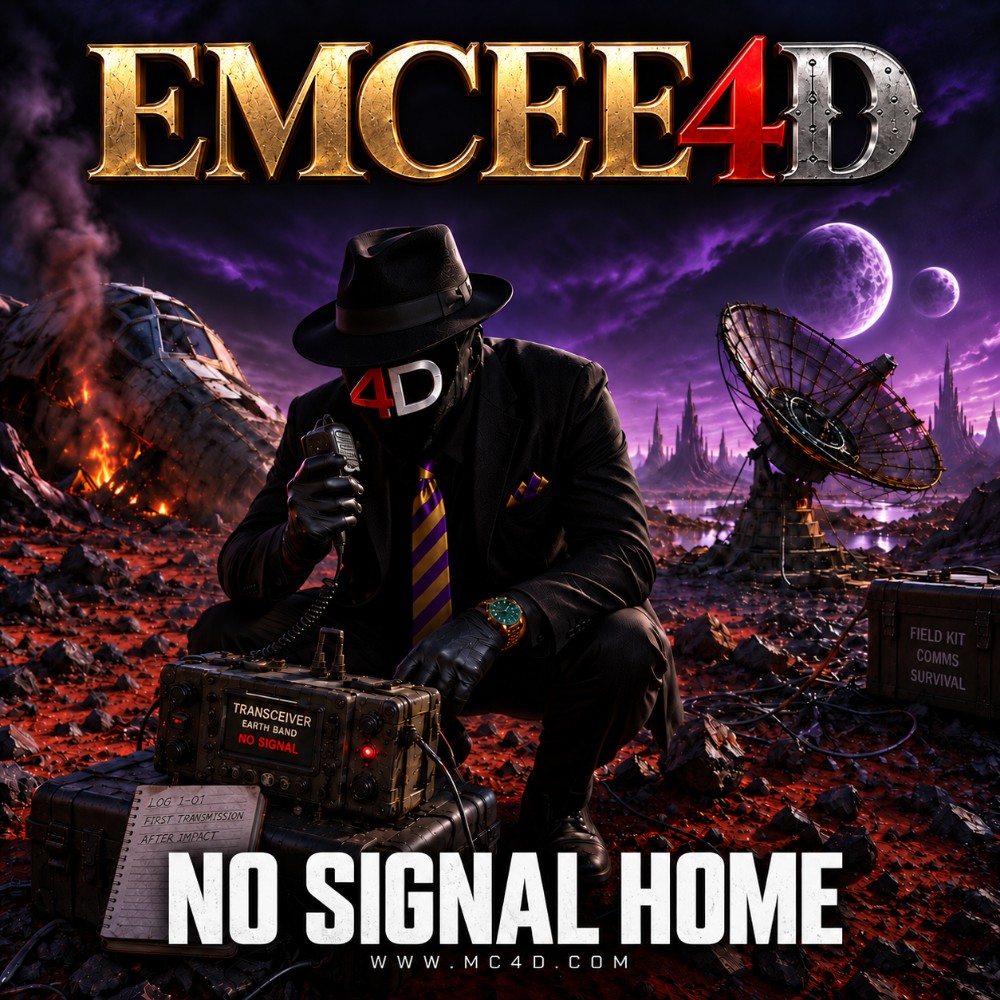
What if home is no longer where he came from?
Gravity Doesn't Know My Name begins with a simple science-fiction premise and then refuses to keep it simple.
EMCEE4D is stranded on a planet that is not Earth.
There is no familiar city beyond the horizon, no person nearby who knows his history and no certainty that a signal sent into the distance will ever reach anybody. The landscape is spectacular, unfamiliar and difficult to read. Survival matters, but survival is only the first problem.
Because once everything familiar has been removed, another question appears.
Who are you when nobody around you knows who you were?
Across 12 tracks, Gravity Doesn't Know My Name removes almost every reference point normally used to define a person. Reputation has no currency here. Past victories and failures have no audience. The expectations attached to an old life cannot easily follow across an impossible distance.
Even a name begins to lose some of its power when nobody recognises it.
That is where the title becomes more than a description of place.
Gravity does not know who EMCEE4D is.
It does not care about reputation, history, ambition or identity. It acts without recognition. On a world where almost everything that once confirmed who he was has disappeared, gravity becomes one of the few certainties left.
But the album gradually gives that word another meaning.
There is physical gravity — the force holding a body to the world beneath it.
And then there is everything else that pulls.
Memory.
Attachment.
Desire.
History.
The emotional weight of somewhere else.
Earth is impossibly distant, yet it remains present through what the narrator remembers. Familiar voices, places and routines acquire a different value when they can no longer be reached. Things that once belonged to ordinary life begin to feel almost unreal through distance.
The old world is absent physically but powerful psychologically.
That tension gives the record much of its shape.
Gravity Doesn't Know My Name is not simply a story about somebody trying to get back to Earth. If returning home were the only objective, the journey would be straightforward.
Instead, the longer the narrator remains away, the more complicated the meaning of return becomes.
The music helps construct that uncertainty.
Experimental sound design is part of the album's world-building, allowing the production to participate in the story rather than simply accompany it. The sonic environment supports the feeling of entering somewhere without familiar reference points: cinematic, unstable and deliberately removed from an ordinary terrestrial setting.
The effect is important.
The alien planet is not only described.
It has to be felt.
The record remains grounded in rap, but the world around that foundation is allowed to behave differently. The experimental elements create distance from the familiar and give the album room to move between isolation, wonder, tension and discovery.
That sense of uncertainty extends to the planet itself.
At first, silence appears to mean emptiness.
Gradually, it becomes harder to interpret.
The environment begins to feel strangely attentive. The distinction between observing the planet and being observed by it becomes less certain. Something about the world suggests that being alone and being unobserved may not be the same thing.
The album never provides a simple explanation for that feeling.
Perhaps the planet is responsive.
Perhaps something is listening.
Perhaps prolonged isolation changes the way silence is understood.
Leaving the question unresolved is more important than solving it.
Because Gravity Doesn't Know My Name is interested in what happens when certainty disappears.
That idea becomes more intimate when another person enters the story.
The human-like alien woman is the first presence capable of changing the planet from somewhere the narrator is trapped into somewhere a life might conceivably exist.
Their attraction is reciprocal.
Understanding is not.
Her appearance contains enough familiarity to make connection imaginable, but familiarity of appearance does not create shared language, shared culture or shared history.
Meaning has to be negotiated.
Translation can transfer words without transferring everything behind them. Gesture becomes important. Observation becomes important. Patience becomes important. A misunderstanding can carry more weight when there is no common cultural background available to explain it.
The relationship therefore becomes more than a romantic element inside a science-fiction narrative.
It becomes a test of connection itself.
How much do two people actually need to share before they can understand one another?
What happens when attraction arrives before language is capable of explaining it?
And can somebody who knows nothing about your past still come to know something important about who you are now?
That last question changes the album.
On Earth, identity comes surrounded by evidence.
People remember earlier versions of you. Places contain associations. A name arrives with history attached to it. Expectations are built from what has already happened.
None of that exists here.
At first, being unknown resembles erasure.
Then it begins to resemble freedom.
Nobody on this planet can insist that the narrator remain the person he used to be because nobody here knew that person in the first place.
The possibility of reinvention emerges almost accidentally.
That does not make reinvention uncomplicated.
History can restrict a person, but it also provides continuity. Memory can prevent movement, but it can also preserve something worth carrying. Leaving an old identity behind may create freedom while simultaneously raising a more difficult question: how much can change before the person doing the changing no longer recognises himself?
The science-fiction setting gives the album enough distance to examine those ideas without reducing them to ordinary realism.
Isolation.
Displacement.
Memory.
Attraction.
Language.
Cultural distance.
Reinvention.
Belonging.
The fear of losing where you came from.
The possibility of discovering that where you came from is not the only place where a future can exist.
Another planet makes those ideas enormous, but it does not make them less human.
As the record develops, the original problem begins to reverse.
At first, the unknown planet represents everything separating EMCEE4D from home.
Later, it starts to contain things that make leaving more difficult.
A landscape that once meant exile begins to contain familiarity.
A stranger becomes less strange.
Communication that initially seemed impossible begins to carry meaning.
The silence changes.
So does the narrator.
That is when the idea of gravity becomes most complicated.
Earth continues to pull because it contains history.
The alien woman creates another pull because she represents connection.
The planet itself begins to pull because a place can stop being foreign long before somebody consciously decides to call it home.
None of those forces completely defeats the others.
That is the contradiction at the centre of Gravity Doesn't Know My Name.
The past can matter without controlling the future.
A person can miss where they came from without belonging there in exactly the same way they once did.
A new connection does not erase an old life.
Reinvention does not require pretending the past never existed.
And home may not be as permanent a concept as distance makes it seem.
The album refuses to settle that tension by simply choosing Earth or the alien world.
Instead, it leaves EMCEE4D between them.
Earth behind him.
An unknown world beneath him.
Another person beside him.
Memory pulling backward.
Possibility pulling forward.
And an identity somewhere between the person who arrived and whoever might eventually remain.
That is what makes Gravity Doesn't Know My Name experimental alien planet rap in more than aesthetic terms.
The experimentation exists in the premise, the storytelling and the sound design, but the questions underneath it are recognisably human.
What does a name mean when nobody knows it?
What remains when history loses its audience?
How much of home is a place, and how much of it is connection?
The album begins with a man stranded somewhere impossible, trying to find a way back.
It becomes a record about something much less certain:
whether going back and going home are still the same thing.
Gravity Doesn’t Know My Name is experimental alien planet rap built as a twelve-track cinematic journey through isolation, survival, attraction, communication, memory, identity and belonging.
It uses an alien world to explore recognisably human questions.
What happens to identity when nobody around you knows your history?
Can distance free you from the past, or does memory travel with you?
Can two people understand each other before they understand each other's words?
Does belonging come from where you were born — or from where you are finally seen?
And if you travel far enough from everything that once defined you, are you still lost?
Or have you finally reached somewhere that allows you to become someone new?
EMCEE4D begins the journey trying desperately to send a signal back to the world that knows his name.
Somewhere along the way, he discovers another world that doesn't need to.
What if home is no longer where he came from?